Being “Just a Developer” Isn’t Enough Anymore
For about a decade, being a developer was… cushy.
If you loved your job as a developer anytime in the last 10 years, you were living the dream.
Good salaries. Endless opportunities. You solved problems, shipped code, and got paid very well for it. No need to worry too much about why the business existed or how money was made. You were the builder. That was enough.
And like all good dreams, this one had an expiration date.
Enter the AI Era
By 2025, AI stopped being a toy and started being a real coworker, more like a junior-mid developer.
It's not a replacement (yet), but definitely a disruptor. The moat of “I know how to code” is shrinking fast. Writing code is no longer rare or magical. It’s becoming cheaper, faster, and more accessible by the month.
At the current pace, who knows where we’ll be by the end of 2026. But one thing is already clear: pure technical execution alone is no longer a long-term advantage.
That sounds scary. It is, at first.
The Silver Lining
AI is a force multiplier. And for once, it’s not locked behind some enterprise-only paywalls. Everyone gets access to it.
Average developers can now ship way more than before.
Good developers can suddenly ship things they never could, even in languages they never learned.
The overall bar for software is going up, and the real winner here is users (hopefully)
Personally, I’m shipping faster than ever, and I enjoy using AI. I have more plans for SaaSykit this year than I realistically could’ve pulled off pre-AI. And that’s the opportunity here.
But there’s a catch.
When everyone can build faster, building alone stops being enough.
So how do you stay valuable?
You don’t stop being a developer.
You stop being only a developer.
1. Business Domain Knowledge Is Your New Armor
For years, many developers proudly said:
“I’ll focus on the code. Business people can handle business.”
Unfortunately, that strategy no longer holds.
Understanding the business you’re building for is now a serious competitive edge. Not vaguely. But deeply.
Metrics, incentives, constraints, customers, regulations, all the unsexy stuff.
I’ve worked with countless brilliant engineers who refused to care about domain knowledge. They were good coders… and easily replaceable, now more than ever.
Compare that to a developer who truly understands, say, fintech. Not just APIs and schemas, but why things are built a certain way, field jargon, what regulators care about, and where companies actually make money. Put that developer in another fintech company and they’ll be productive before the onboarding docs are finished.
AI is getting exceptionally good at writing and moving code around. But business is still built on people — their incentives, fears, constraints, and politics. That layer is messy, emotional, and context-heavy, and it’s where humans (YOU) still have a real edge.
2. Go Wider, Not Just Deeper
For a long time, the advice was simple: specialize harder.
Learn the framework. Master the stack. Go deep.
Deep expertise still has value, but it’s no longer enough on its own to protect you.
Backend engineers: you don’t need to become a design master, and frontend engineers: the browser is only half the story. It's now easier than ever to think (and do) full-stack, to build from A to Z. And you don’t have to know everything. AI can fill in the gaps for you.
Moreover, knowing DevOps, security, performance, and reliability keeps your apps alive, and keeps you valuable. AI can churn out features all day, but it can’t handle a live outage, patch a security hole at midnight, or make sure your app actually works for real users. Developers who can manage the messy, unpredictable side of running software are the ones who will stay irreplaceable.
And don’t stop at code. Think like a product person. Understand the basics of marketing so your work actually reaches people. Write clearly enough that someone else can read it without squinting. And yes, learn to talk to users without turning into a nervous wreck. These skills may not be in your job description, but they’re what keep you relevant when AI can handle the code.
You don’t need to be an expert at everything—but you should no longer be blind outside your lane.
3. Build Your Own Apps
Nothing sharpens your skill faster like doing it all and becoming the single point of failure. When you move beyond the IDE and take responsibility for the entire lifecycle of a product, your perspective shifts.
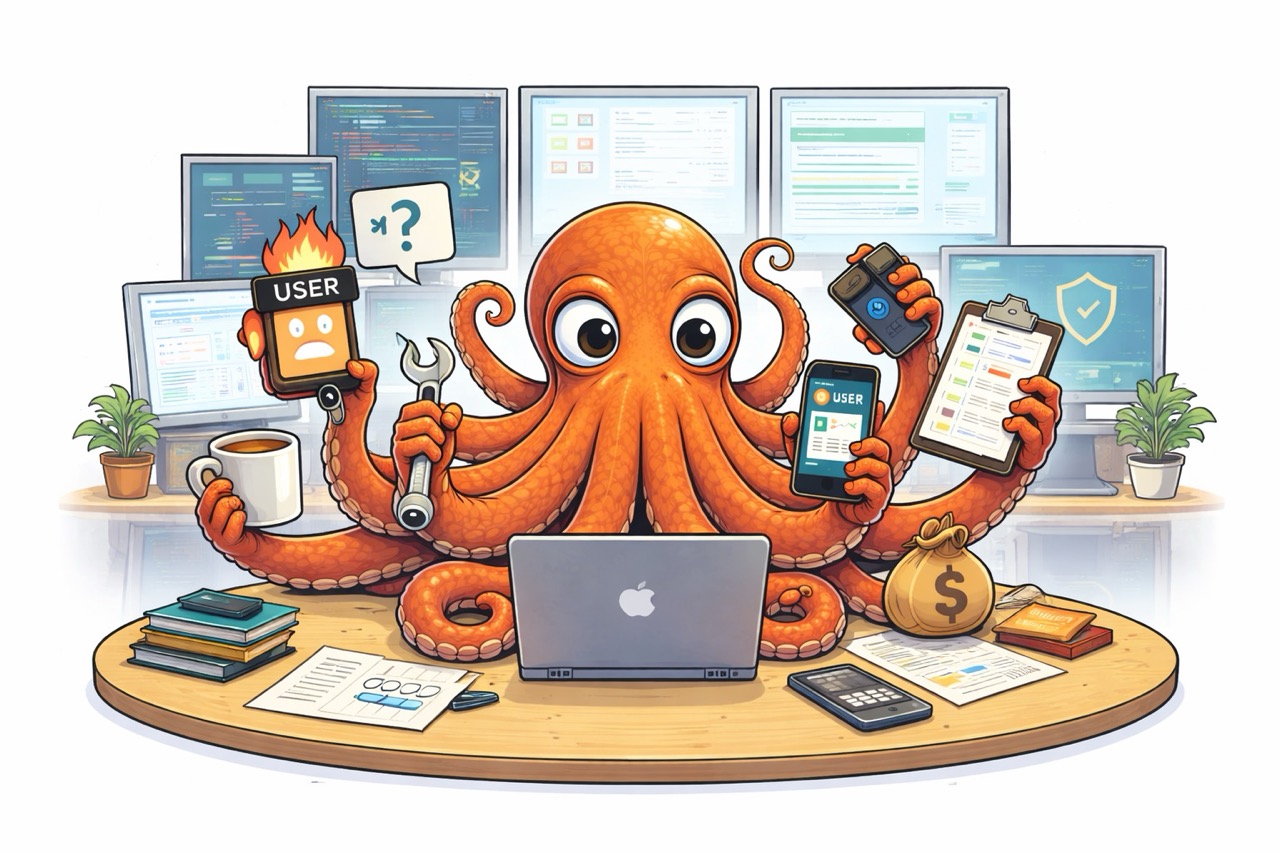
By wearing every hat - hosting, pricing, onboarding, and marketing - you transform from a specialized "cog" into a full-stack founder. This makes you lethal in the job market as a developer, but it also prepares you for a life where you don't need a job market at all.
And AI makes this more doable than ever.
If you have 2–3 hours a day, you can now get weeks of progress out of them. You are only limited by your ability to direct the tools. What used to be overwhelming is now achievable, even with a full-time job.
Relying on a single paycheck is a concentrated risk. Building your own revenue stream, even if it starts at a modest $500 or $1,000 a month, completely changes your relationship with your "day job." It’s about de-risking your livelihood. When you own a revenue stream (even a small one) the power dynamic of your day job shifts. You’re no longer just a line item on a corporate spreadsheet; you’re someone with 'walk-away power.' It’s the difference between needing a job and choosing one.
The Movie Just Started
This does feel like an existential moment for developers. And it is.
This isn't a crisis of the profession; it’s an evolution of the developer job description. The baseline has moved. Success now requires more than just being a 'technical resource.' It requires the ability to see the whole board, to stop viewing code as the end product and start seeing it as one tool in a larger kit used to solve a business problem.
Don’t aim to be “just a developer.”
Be the developer who also understands business.
Who can think in products.
Who can ship, explain, and iterate.
AI can write the code. But it can’t navigate people, trade-offs, or the chaos of real users. The more you step beyond your keyboard and take ownership of the whole picture, the more indispensable you become, and the harder it is to replace you.
Keep pushing. 💪